
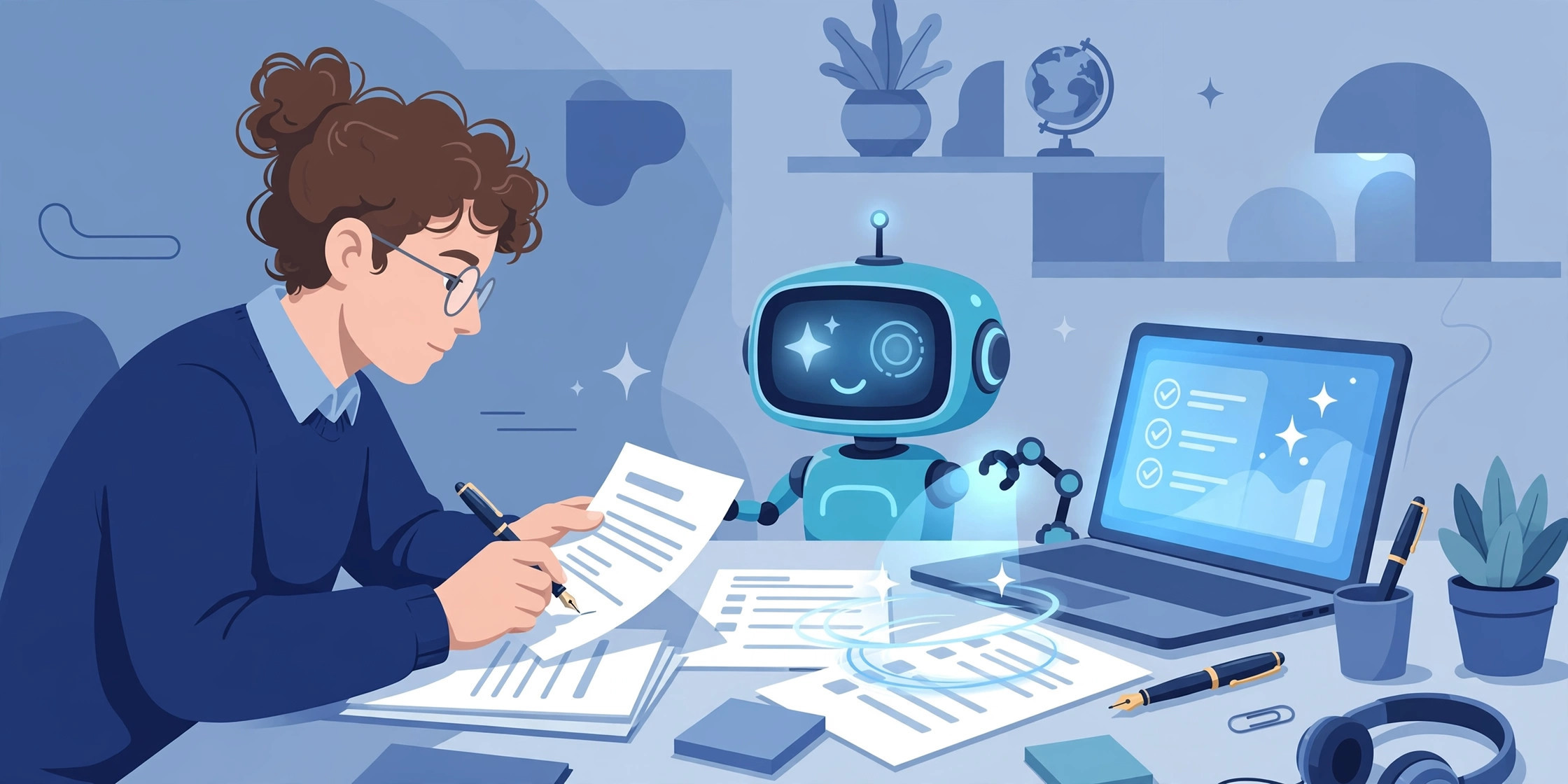
I once spent six hours perfecting a cover letter for a job I really wanted. Six hours, one page, endless rewording of the same three sentences. I never heard back.
Two weeks later, I applied to a similar job with a letter I drafted with AI in twenty minutes — then edited it myself for another twenty. I got an interview.
The difference wasn't that AI is magic. It was that I stopped treating the cover letter as an art project and started treating it as what it actually is: a clear, confident argument for why you're worth an interview. And in 2026, AI is genuinely the best drafting assistant you'll ever have — if you use it right.
Here's how to use AI to write a CV and cover letter that actually get interviews, plus the mistakes that get AI-written applications thrown out.
Start with the CV: Structure First, AI Second
AI writes better when it knows exactly what it's working on. Don't open a chatbot and type "write me a CV." That's how you get generic filler that recruiters spot in seconds.
Start with the raw material: your work history, skills, education, and projects — messy bullet points are fine. Paste the job description you're targeting too. Then give the AI this kind of brief:
"Act as a hiring manager in [industry]. Rewrite these bullet points into strong CV achievements using numbers where possible. Keep the tone professional and confident. Flag anything that sounds vague or weak."
What AI does well here: turning "helped with social media" into "grew Instagram engagement 40% in four months by posting three times a week and replying to every comment." It asks you questions, in effect, that force you to remember your actual results.
What you must do yourself: verify every number. AI will sometimes invent metrics to make a sentence sound stronger. A fabricated number in an interview is worse than a weaker but honest bullet. This is the one rule you never break.
Tailor Every Application (Yes, Every Single One)
This is where most people lose. Recruiters can tell in about ten seconds whether a CV was tailored to their posting or fired off to fifty companies. And here's the secret: tailoring used to take an hour per application. With AI, it takes fifteen minutes — so there's no excuse left.
My workflow for each application:
1. Feed the AI the job description. Ask it: "What are the five most important requirements in this posting? Quote the exact language the company uses."
2. Mirror the language. Ask: "Rewrite my CV bullets to naturally include these keywords, without lying about my experience." Companies use applicant tracking systems (ATS) that filter CVs by keyword match before a human ever sees them. Same skills, different words, can be the difference between rejection and an interview.
3. Reorder, don't invent. Move the most relevant experience to the top. AI helps you see your own history through the employer's eyes — but never let it add skills you don't have. One technical interview will expose it, and it poisons your reputation in that company forever.
Once this becomes a habit, applying takes twenty minutes instead of two hours. Most job seekers are competing against people who apply to everything with one generic CV. You're now competing against almost nobody.
The Cover Letter: Short, Specific, Human
Here's my honest opinion: most cover letters are terrible, AI or not, because they're long and say nothing. The good ones follow a simple formula, and AI drafts it fast:
- Paragraph 1: Which role, why this company specifically (one real detail — a product, a campaign, a value — not "your esteemed organization").
- Paragraph 2: Your two or three strongest relevant achievements, tied directly to what the job needs.
- Paragraph 3: One line about your enthusiasm, one line about availability. Sign off.
Tell the AI: "Write a 180-word cover letter for this role. Mention [one real company detail]. Keep it warm but direct, no corporate jargon, no phrases like 'I am writing to express my interest.'"
Then — and this is the part people skip — rewrite at least a third of it in your own voice. Add one specific detail only you know: a story from a previous job, a genuine reason you care about the industry. That's the human fingerprint AI can't fake. The letters that get callbacks aren't the most polished ones. They're the ones that sound like a real person who actually wants this specific job.
Prompts That Actually Work
Generic prompts give generic documents. Here are the prompts I actually use, adapted from years of experimenting — and if you're still learning the tool, start with the basics of getting more out of ChatGPT first:
For the CV: "Rewrite my work history into achievement-focused bullets using the XYZ formula — 'accomplished X, measured by Y, by doing Z.' Remove all weak verbs like 'assisted' and 'helped.' Keep each bullet under two lines."
For the cover letter: "Here's the job description and my CV. Write a 150-word cover letter that connects my two strongest achievements to the job's top requirements. Conversational tone. Do not use the phrases 'passionate,' 'team player,' or 'fast-paced environment.'"
For the sanity check: "Act as a skeptical recruiter. Read my CV and cover letter and list every line that sounds generic, exaggerated, or AI-generated. Be brutal."
That last prompt is the most valuable one. AI is excellent at drafting and terrible at knowing when it sounds like everyone else. Use it to write, then use it to criticize its own work.
Reality Check: What AI Can't Do for You
Let me be straight about the limits, because they matter more than the techniques.
AI cannot give you experience you don't have, and trying to fake it is the fastest way to ruin a job search. It cannot network for you — most jobs still come through people, not applications, and no prompt replaces a warm introduction. It cannot do the interview. If your CV sounds brilliant but you can't speak to it in person, the whole thing collapses.
And here's the market reality: everyone now has access to the same AI tools. When every applicant uses them, "used AI well" stops being an advantage and becomes the baseline. The edge comes from the parts AI can't touch — real results, genuine enthusiasm, and follow-through. My roadmap for earning your first $100 online makes the same point about freelancing: tools level the playing field, and then the humans who show up consistently win.
Use AI to remove the busywork so you can spend your energy where it actually counts: researching companies, preparing for interviews, and following up like a professional.

FAQ
Will recruiters reject my application if they can tell AI helped?
No. Recruiters reject applications that are generic, dishonest, or clearly written with zero thought. Plenty of hiring managers use AI themselves. What gets you rejected is a cover letter that could have been sent to any company — whether a human or AI wrote it. Tailoring and honesty are what matter, not who drafted the first version.
Can AI beat applicant tracking systems (ATS)?
Yes, for the keyword-matching part. Feed AI the job description, have it mirror the posting's language in your CV, and you'll pass the automated filters that reject most generic applications. Keep formatting simple — single column, standard headings, no tables or graphics — because fancy layouts confuse ATS software more than any chatbot does.
Is it dishonest to use AI on my CV?
Using AI to express your real experience more clearly is not dishonest — it's what career coaches and professional CV writers have done for decades. It becomes dishonest the moment AI adds skills, numbers, or achievements you don't have. Your experience must be yours; AI just helps you say it better.
How long should my CV be?
One page if you have under ten years of experience, two at most if you're senior. No recruiter has ever complained that a CV was too short and specific. AI's biggest weakness is length — it rambles. Cut ruthlessly, and keep only what a hiring manager for this specific role would care about.
One Last Thing
Here's what I'd tell a friend starting a job search tomorrow: spend one evening building your master CV with AI — all your experience, every achievement, numbers included. Then, for each application, spend twenty minutes tailoring it to the posting with the prompts above. That's it. That's the whole system.
The people getting hired in 2026 aren't the ones with the fanciest tools. They're the ones who stopped sending generic applications and started sending specific ones. AI just makes "specific" cheap.
And if the traditional job route isn't your only plan, the same writing skill transfers directly to freelancing — my Upwork profile tips that actually attract clients apply the same principles to winning clients instead of employers.
Good luck out there. Go get the interview.